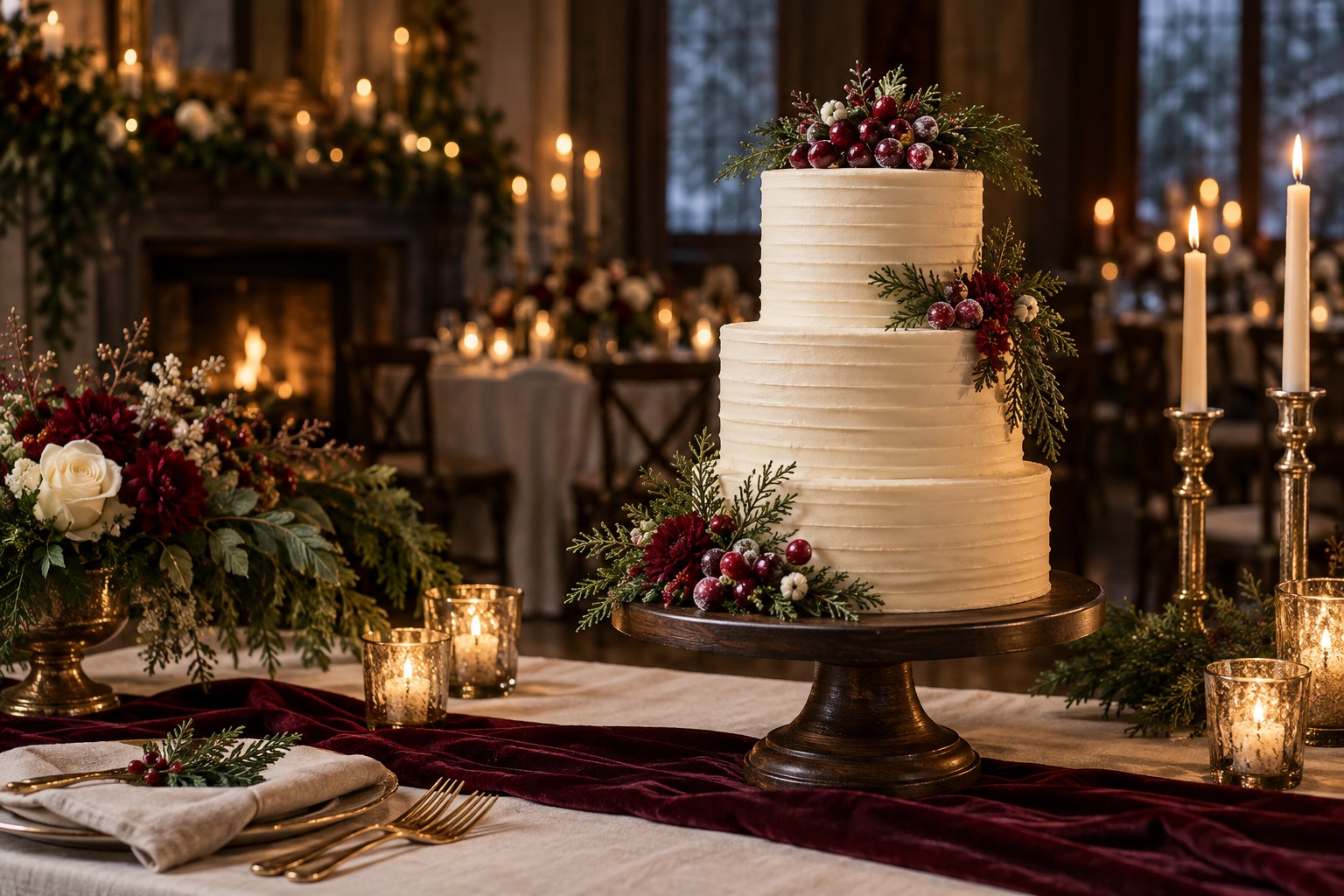
Christmas Wedding Cake Ideas: Solve the Big Decisions
A Christmas wedding cake has a difficult job. It needs to look special in a room already filled with candles, flowers, greenery, velvet, and seasonal details, while still tasting like a dessert both of you genuinely want to eat. It also has to arrive intact during a busy time of year, serve the right number of guests, and feel welcoming to people who celebrate the season in different ways.
The most common mistake is treating the holiday as a decoration instead of a design problem. A cake covered in random ornaments can feel more like a store display than part of a wedding. The better approach is to identify the friction first: too much Christmas, too little personality, too many flavor opinions, an uncertain guest count, or a venue that creates delivery concerns. Then solve one decision at a time, using the season as a source of color, aroma, texture, and mood.
When the cake feels too much like Christmas
If your first sketches include holly, candy canes, red bows, snowflakes, ornaments, pinecones, and a Santa-inspired topper all at once, pause before sending the list to your baker. The issue is not that any one detail is wrong. The issue is that several symbols compete for attention, leaving the cake without a clear point of view. Wedding cake design works best when the eye can understand the main gesture quickly.
Your wedding look is only the beginning.
Keep your guest list, vendors, timeline, and every important detail together with Zarellea — so your day feels as considered as your style.
Choose one seasonal signal
Pick one primary Christmas signal and let the rest of the cake support it. That signal might be a deep cranberry palette, a ring of evergreen, a ribbon-like buttercream border, a warm spice flavor, or a candlelit presentation. If you choose greenery, keep the frosting quiet. If you choose dramatic red tiers, use metallic accents sparingly. If the flavor carries the holiday feeling, the exterior can stay almost entirely classic.
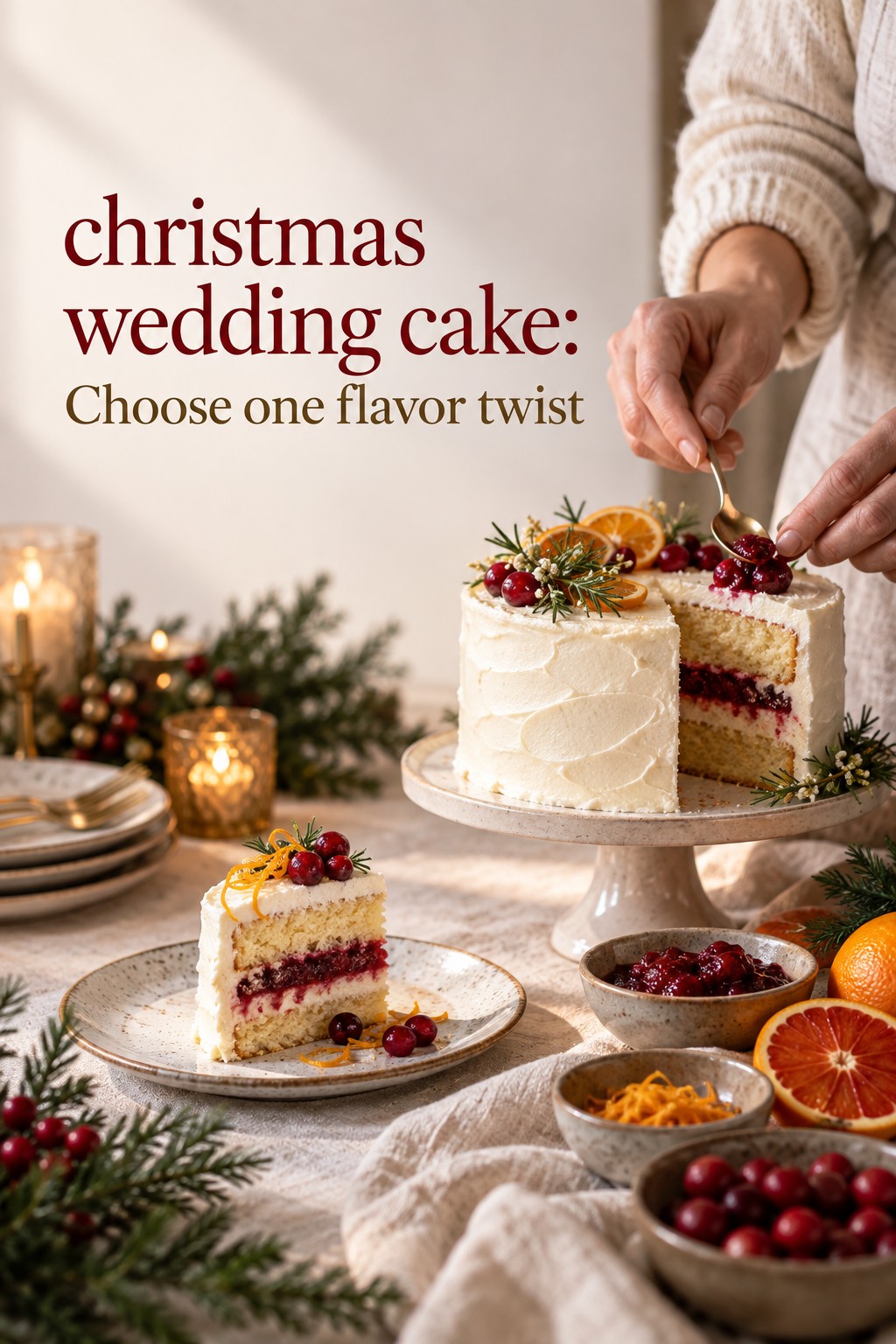
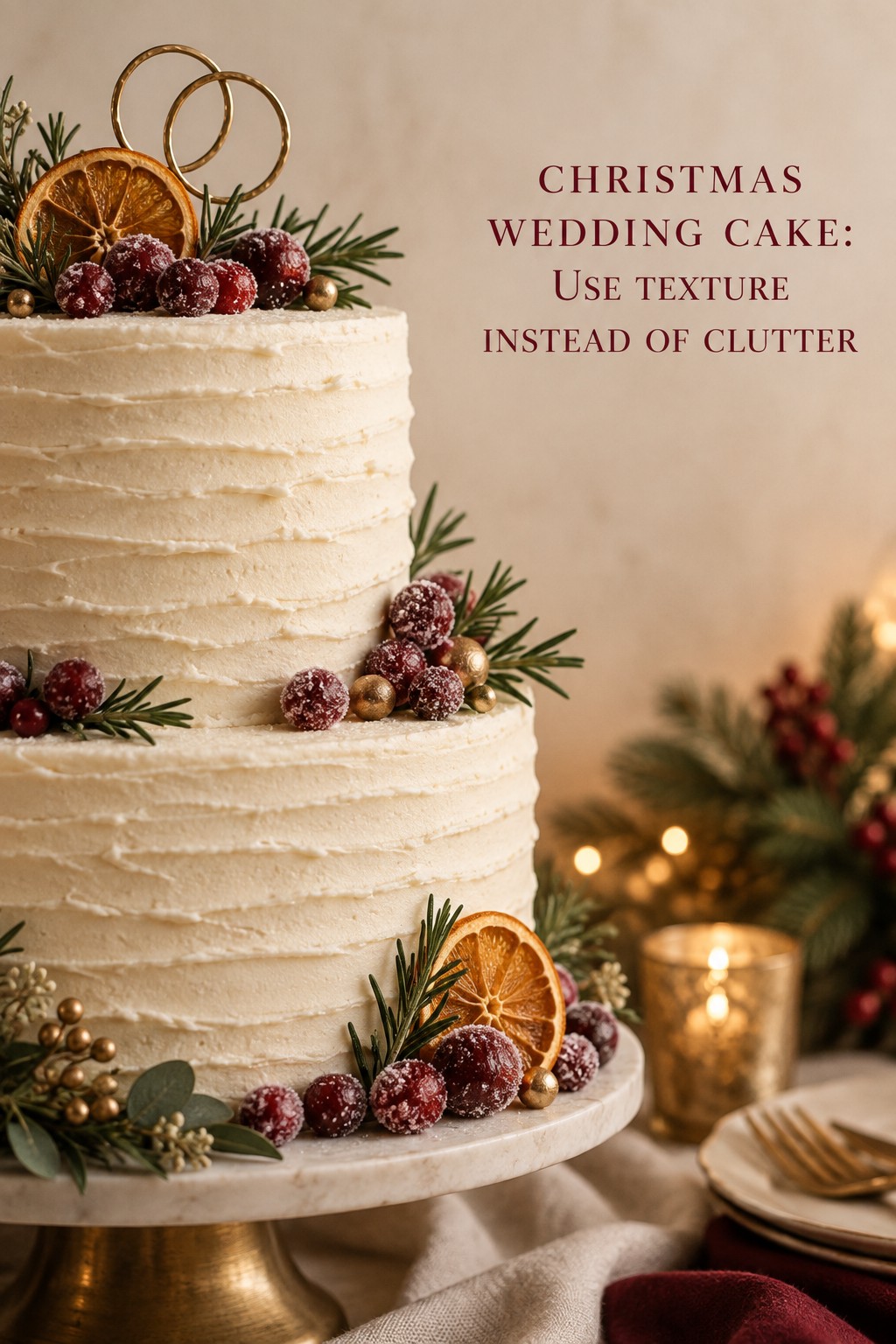
This method creates a cake that reads as seasonal without requiring literal icons. A white buttercream cake with a narrow burgundy ribbon and a few sugared cranberries feels festive because the color and texture do the work. A pale cake with piped fir branches feels wintry because the line quality is specific. A chocolate cake with orange zest and cranberry filling can communicate Christmas at the tasting table, even if the finished design is simple.
Separate Christmas, winter, and holiday-neutral moods
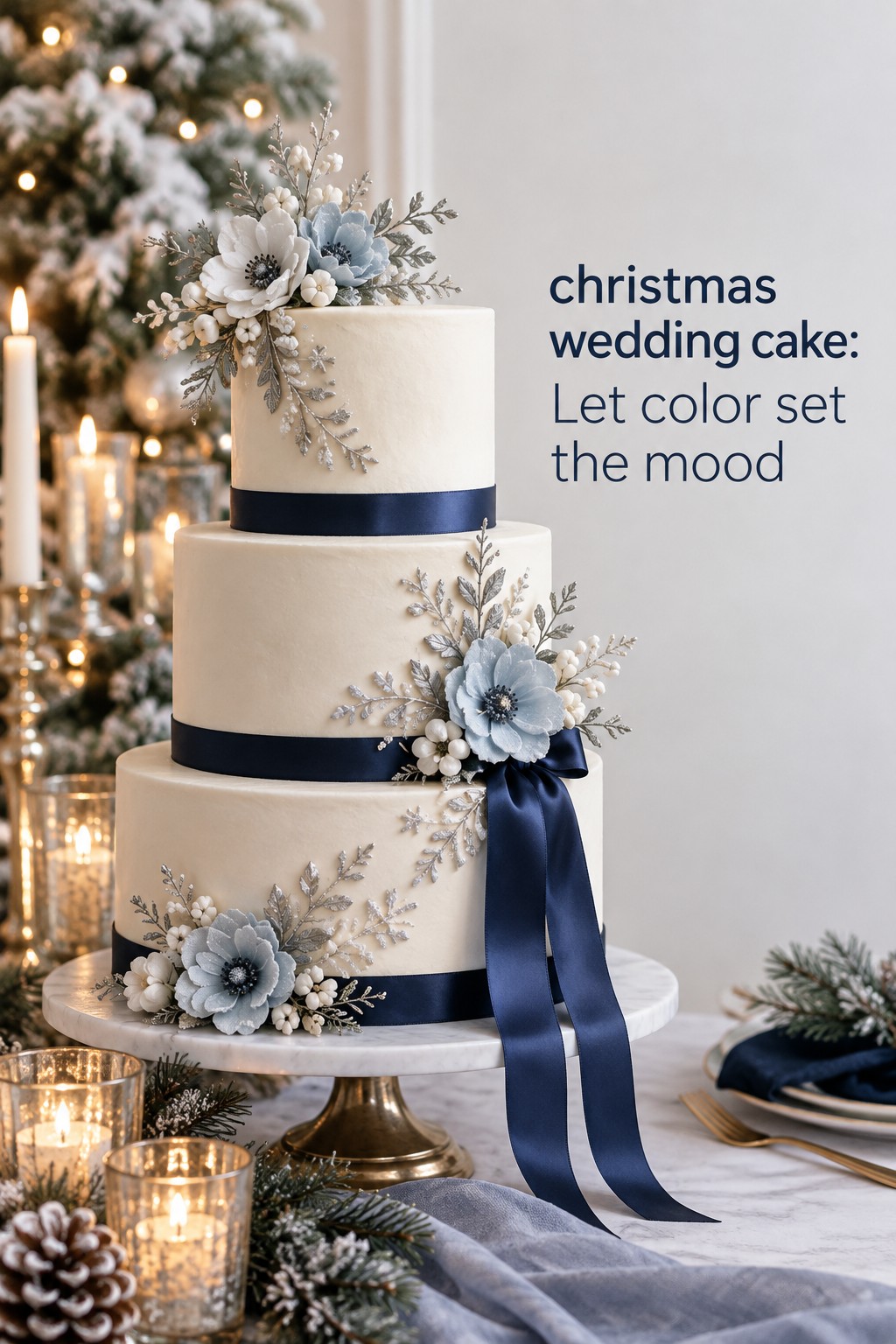
Before choosing colors, decide which seasonal story you actually want. A Christmas-forward cake can use cranberry, evergreen, candlelight, gold, and warm spice. A winter cake can move toward icy blue, silver, white, pear, citrus, and translucent textures. A holiday-neutral cake can focus on ivory, champagne, taupe, soft green, or a single dark accent, allowing the date to remain part of the atmosphere without making the cake about one holiday.
- Choose Christmas-forward if the holiday is central to your ceremony, family traditions, or reception experience.
- Choose winter editorial if you want snow, candlelight, or alpine references without a traditional Christmas palette.
- Choose holiday-neutral if your guest list includes varied traditions or the wedding takes place close to, but not during, Christmas.
Showing your baker a mood board with one of these labels is more useful than sending twenty unrelated cake photos. It gives the design a filter. When a new idea appears, you can ask whether it strengthens the chosen mood or simply adds another seasonal object.
When everyone wants a different flavor
Flavor conflict is common because couples often use the cake to represent different memories. One person wants chocolate and peppermint, another wants vanilla and berries, and family members suggest fruitcake, gingerbread, or red velvet. You do not need to force every preference into one dense combination. You need a tasting strategy that separates the decisions and lets the finished cake feel intentional.
Build a familiar base with one seasonal twist
The safest Christmas wedding cake flavors begin with a familiar cake and add one distinctive filling or finish. Vanilla cake can become winter-ready with cranberry compote, orange curd, pear, or vanilla bean buttercream. Chocolate can pair with peppermint, espresso, cherry, hazelnut, or salted caramel. Almond cake can move toward the season with spiced pear, fig, cranberry, or citrus. Red velvet already supplies a rich color and works naturally with cream cheese frosting.
Use the seasonal ingredient as an accent rather than stacking every winter flavor into one tier. Orange, cranberry, cinnamon, clove, peppermint, and chocolate may all belong in the same holiday pantry, but that does not mean they belong in the same bite. Ask your baker which combinations stay balanced after the cake is chilled, transported, and served several hours after assembly.
Give each tier a role
For a multi-tier cake, assign each tier a clear role instead of making every layer equally experimental. The bottom tier can be the crowd-pleasing option, such as vanilla with berry filling or chocolate with salted caramel. The middle tier can carry the holiday idea, such as spice cake with apple compote, gingerbread with cream cheese buttercream, or orange cake with cranberry filling. The top tier can be the couple’s more personal choice.
This structure protects guests who prefer familiar flavors while giving the couple room to be specific. Label the flavors on a small menu if the tiers are not obvious when sliced. If you are serving multiple desserts, let the cake be the polished centerpiece and use cookies, mini pies, cupcakes, or chocolate truffles to add the flavors that do not work well in a tall tiered cake.
Test texture, sweetness, and aroma at the tasting
A holiday cake can become heavy quickly. Dense spice cake, ganache, caramel, buttercream, and fondant may look beautiful together but overwhelm the palate. Taste each proposed pairing in a realistic portion. Notice whether the filling disappears, whether the frosting feels too sweet, and whether the flavor still feels appealing after two or three bites. Aroma matters too. Orange zest, toasted nuts, rosemary, coffee, and warm spices can make a small slice feel more layered without adding more sugar.
When the design and reception do not match
A cake can be beautiful on its own and still feel wrong in the room. A highly ornate red-and-gold cake may compete with a minimal reception. An icy white cake may disappear against a room full of dark wood and warm candlelight. A rustic semi-naked cake may look out of place in a formal ballroom. The solution is to design the display as part of the reception, not as a separate image copied from a cake gallery.
Match the cake to the strongest room material
Look at the material guests will notice most. If your reception uses velvet, choose a cake finish with soft movement, such as buttercream swags, pleats, or a brushed texture. If the room is filled with polished metal and glass, a smooth cake with restrained metallic leaf may feel more connected. If the venue is a cabin, barn, or historic house, a textured finish, fruit, or a simple wood-toned stand can ground the display without making the cake look rustic by default.
Color should follow the same principle. Navy and gold can feel like a winter night. Burgundy and ivory can feel heritage-inspired. Forest green and cream can feel botanical. Pale blue and silver can feel crisp. You do not need all four. Choose two dominant colors and one small accent, then allow the frosting itself to provide the neutral space.
Use flowers and greenery safely
Fresh flowers, evergreen, herbs, berries, and pinecones need a clear plan before they touch the cake. Ask your baker and florist which materials are food-safe and how they will be inserted or separated from the edible surface. Some greenery looks seasonal but is not appropriate for direct contact with food. A food-safe barrier, a floral pick, or a sugar version may be needed.
For a lighter approach, use sugar flowers, piped greenery, edible gold, dried citrus, sugared cranberries, or a painted winter motif. These details can be placed exactly where the composition needs them, and they remain part of the baker’s design rather than an afterthought added during setup.
Make the stand and backdrop part of the solution
If the cake design feels too plain, improve the environment before adding another tier or more frosting. A textured linen, a dark wood stand, a shallow bowl of cranberries, or a few candles can give a simple cake a stronger presence. A cake table should have enough negative space for the silhouette to read. Do not hide the tiers behind large florals, and do not place open flames so close that heat can soften frosting or create a safety concern.
When servings, budget, and delivery become stressful
The most glamorous cake plan can fail if the quantity, budget, or delivery conditions are vague. December weddings add pressure because bakeries, florists, venues, and transportation teams may be managing holiday schedules. Solve logistics early, and you will have more freedom to make the design personal.
Decide whether the cake is the whole dessert
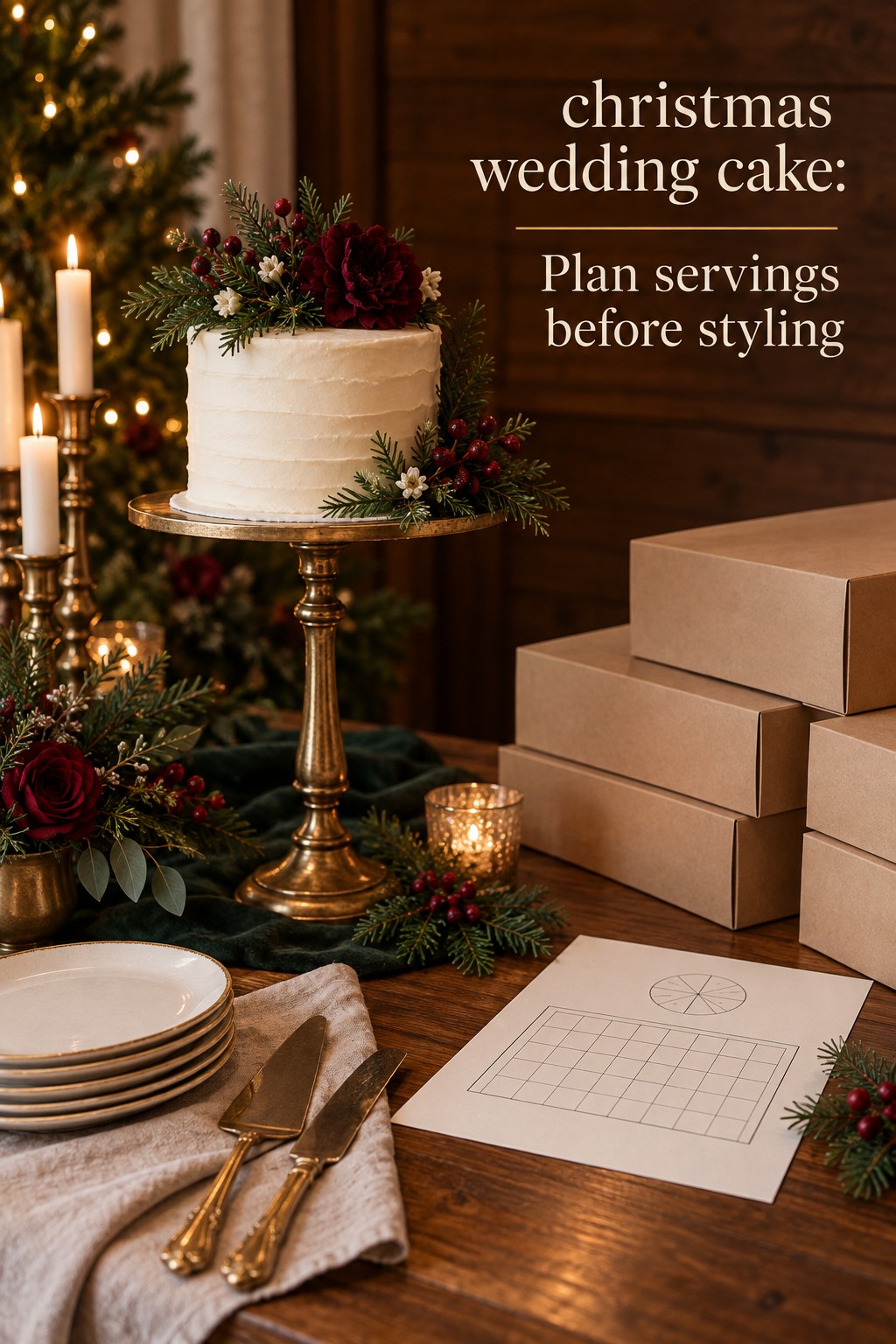
Start with the serving plan. If every guest receives cake, order for the full count and tell the baker how slices will be served. If the cake is part of a dessert table, the required number may be smaller, but the reduction should be intentional. A display cake with sheet cake served from the kitchen can create a tall, photographable centerpiece without paying for every serving to be baked and decorated as a tier.
Ask how your baker calculates servings because cutting styles differ. Square tiers can yield more portions than round tiers, and a cake with very tall layers may be cut differently from a standard-height cake. Include your guest count, expected children, other desserts, late-night snacks, and any plan to save a top tier when requesting a quote.
Spend on the detail guests will actually see
When the budget is tight, protect the elements that affect both photos and taste. A well-made buttercream finish, a strong flavor pairing, and a thoughtful stand usually create more impact than many delicate add-ons. Choose one expensive detail, such as hand-piped Lambeth work, edible metallic leaf, sugar flowers, or a custom topper, and simplify the surrounding tiers.
Ask whether a sheet cake, cutting cake, or smaller tiered display can preserve the look. Also ask which decorative elements can be prepared in advance and which require additional labor on the wedding day. A clear quote should identify delivery, setup, stand rental, cutting fees, additional tiers, special flavors, dietary accommodations, and taxes.
Plan for cold weather and heated rooms
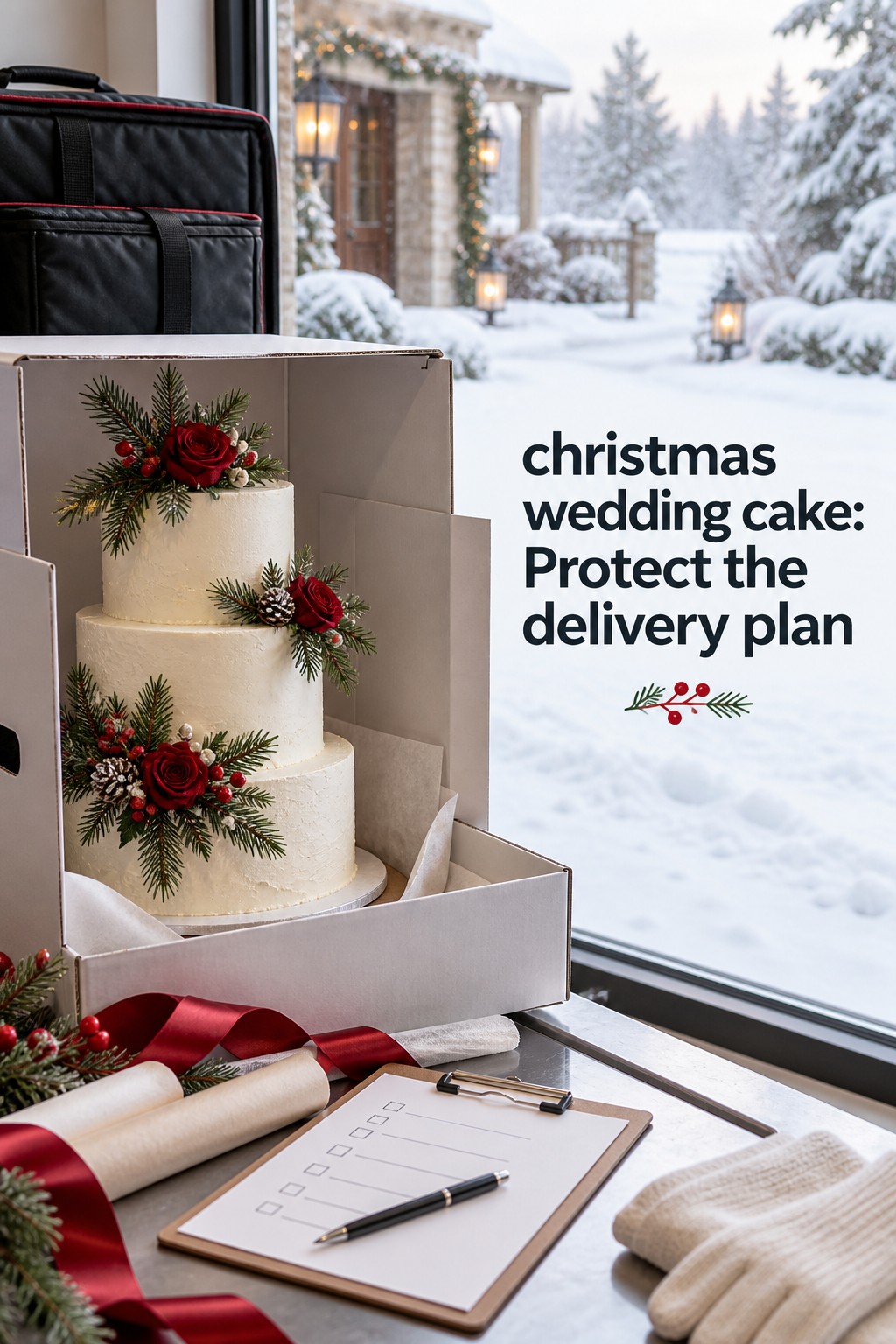
Winter weather does not automatically make cake transport easy. Snow, ice, traffic, and holiday events can delay a delivery, while a heated ballroom can soften buttercream or compromise chocolate details. Give the bakery the venue address, loading instructions, setup deadline, elevator information, and a contact person who will answer the phone. Confirm who supplies refrigeration and where the cake will wait before the reception.
Ask about the stability of your chosen filling and finish. Whipped cream, mousse, fresh fruit, and some buttercreams may need specific temperature control. If the cake must travel a long distance, your baker may recommend a sturdier design, separate tier delivery, or a simpler filling. The right question is not whether a dream cake is possible in theory. It is whether it can arrive safely at your particular venue and be served at its best.
Keep dietary needs in the design conversation
If you need gluten-free, dairy-free, nut-free, egg-free, or vegan servings, tell the baker before the tasting rather than treating them as a last-minute substitution. Cross-contact procedures matter, especially when an allergy is involved. A separate small cake or a coordinated dessert can be safer and more appealing than asking one recipe to satisfy every requirement.
Make the plan visible to the catering team. A beautiful menu card can name the flavors, but the service team should also know which slices require special handling. This prevents guests from having to explain their needs at the cake table and makes the dessert experience feel considered rather than segregated.
Quick fixes for a cake that still feels undecided
If you have a collection of ideas but no final direction, make three decisions today. First, write one sentence describing the guest experience: candlelit and formal, cozy and rustic, crisp and wintry, or playful and nostalgic. Second, choose two colors plus one accent. Third, select one flavor pairing that both of you would order outside the wedding. These decisions create enough structure for a productive baker conversation.
- Too literal: remove half the symbols and keep one seasonal material, color, or flavor.
- Too plain: add texture, a distinctive stand, or a single intentional garnish before adding more tiers.
- Too expensive: keep the display cake small and supplement with sheet cake or coordinated desserts.
- Too sweet: request tart fruit, citrus, coffee, toasted nuts, or less-sweet Swiss buttercream.
- Too many opinions: assign one person to visual decisions and one person to flavor decisions, then let the baker mediate pairings.
- Too risky to transport: simplify the filling, reduce fragile decoration, and confirm temperature control with the venue.
Finally, photograph or describe the cake next to the reception details that will surround it. If it works with the linens, flowers, candles, and menu typography, the cake is probably part of the wedding rather than a separate seasonal prop. The goal is not to prove that you are having a Christmas wedding. The goal is to make guests feel the season through a dessert that tastes personal, looks intentional, and arrives ready for the moment you cut it.
FAQ
What flavors work best for a Christmas wedding cake?
Start with familiar flavors and add one seasonal accent. Popular directions include vanilla with cranberry or orange, chocolate with peppermint or espresso, almond with spiced pear, red velvet with cream cheese buttercream, and spice cake with apple or salted caramel. Taste the full pairing, not only the sponge, because frosting and filling determine the final sweetness and texture.
How can I make a Christmas cake look elegant?
Use one dominant seasonal signal, two main colors, and generous negative space. A smooth ivory cake with burgundy ribbon, a restrained evergreen detail, or a few sugared berries can feel more elegant than many holiday symbols. Match the finish to the venue and let the cake stand, candles, or table linen support the seasonal mood.
Should a Christmas wedding cake use red and green?
Only if those colors suit your wedding. Red and green can be refined when they are deep, muted, or balanced with ivory and metallic accents, but navy, silver, champagne, pale blue, burgundy, or forest green can create equally seasonal results. Choose colors that connect to the reception instead of using a traditional palette automatically.
How much cake do I need for my wedding?
Tell your baker the guest count, serving style, other desserts, and whether you want leftovers or a saved top tier. The correct size depends on the shape and cutting method as well as the number of guests. A smaller display cake with sheet cake can provide the visual height and enough portions at a lower cost.
Can I use fresh evergreen or pine on a wedding cake?
Do not place greenery on a cake until your baker and florist confirm that it is food-safe and can be separated from the edible surface. Some seasonal plants are not safe for direct contact. Piped buttercream branches, sugar greenery, edible herbs, or a properly protected floral installation can create the same visual effect with better control.
When should I book a baker for a Christmas wedding?
Book as early as your date and local market require, and mention the holiday timing when you inquire. December weekends can overlap with corporate events, family celebrations, and bakery closures. Early booking gives you more choice of flavors, delivery windows, and design labor, especially if you want sugar flowers, hand piping, custom toppers, or a multi-tier cake.
Is buttercream or fondant better for a winter wedding cake?
Neither is universally better. Buttercream offers flavor, softness, and texture, while fondant provides a smooth surface for sharp edges, painting, and detailed decoration. Your baker can recommend the finish based on the design, travel conditions, venue temperature, and filling. Consider the bite as carefully as the photograph.
What is a good alternative to a large Christmas wedding cake?
A one-tier cutting cake with sheet cake, cupcakes, mini pies, cookies, or a dessert table can be a practical alternative. You can still create a strong seasonal centerpiece with the stand, menu, candles, and styling. This format also lets guests choose among several flavors and makes dietary accommodations easier to organize.